For Product Owners
Every vague story becomes a question in stand-up. Every gap in the requirements becomes a rework ticket. Gensudo helps Product Owners write documents a delivery team can run on — 77 governed templates with guidance on what good looks like.

A Product Owner is the team’s single source of answers. When a developer asks what done means, when a designer asks which user this serves, or when a stakeholder asks why their request is not in the sprint, the answer should already exist in the work.

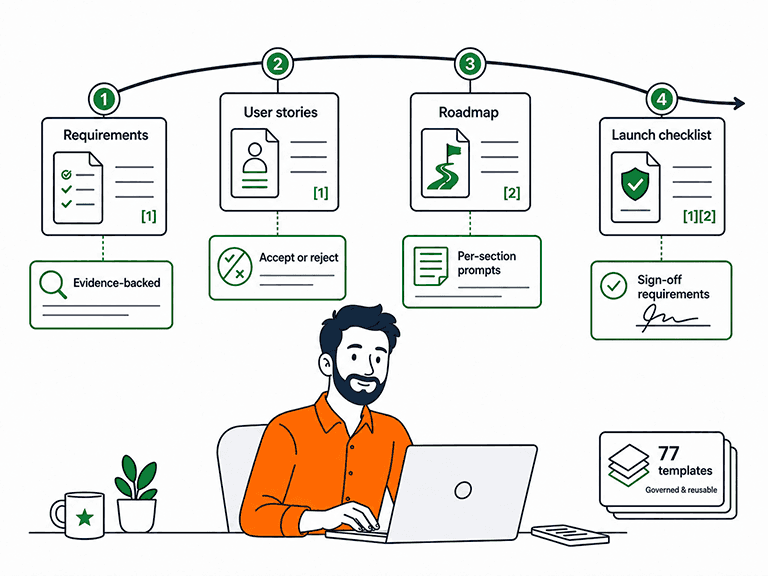
Gensudo helps Product Owners turn project context into the clear, evidence-backed documents a delivery team runs on - from user stories and requirements to roadmaps and launch checklists. With 77 governed templates, per-section prompts and AI drafts that arrive as suggestions for you to accept or reject, Gensudo helps you move faster while keeping control. Templates also include sign-off requirements, so the documents you hand to the team answer the questions before they get asked.
Product Owners get 77 governed templates in Gensudo, and the shape is telling: 13 in Discover, 13 in Plan and 13 in Build. Owning a backlog means understanding the problem, ordering the work and staying present all the way through delivery - the library is built the same way.
Grounding the backlog in real users: the Persona Document and the Jobs-to-be-Done Analysis stop the backlog becoming a list of stakeholder wishes.
PO discover templates →The case for the work: an Opportunity Assessment or a Business Case that explains why this initiative deserves the team's next quarter.
PO validate templates →Order from ambition: the Product Roadmap and the RICE Scoring Sheet make prioritisation something you can show, not just assert.
PO plan templates →Small in count, huge in consequence. User Stories and the Product Requirements Document (PRD) are where ambiguity either dies or gets shipped.
PO define templates →Joint-largest phase for this role, because a Product Owner does not disappear once the sprint starts: stories kept current as scope shifts, the Customer Journey Map updated as the built product diverges from the imagined one.
PO build templates →A heavier launch phase than most roles carry. The Product Launch Checklist leads, with a Demand Validation Report as a final check that the demand evidence still stands before release.
PO launch templates →Feeding reality back into the backlog: a Product-Market Fit Assessment or a refreshed Competitive Analysis turn what launched into what gets prioritised next.
PO optimise templates →When a product winds down, the Product Sunset Assessment and the Product Retirement Business Case give the team an orderly ending instead of a fading backlog.
PO scale or sunset templates →Less time drafting, no context repeated twice, and every document visible in the flow of delivery.
A full draft is charged once, sections draft one at a time, and a failed run resumes without re-charging. Per-section Improve preserves your facts and figures, and every suggestion waits for your accept or reject.
AI document drafting →A project fact store lets later documents reuse facts established in earlier ones — the numbers in your business case flow into your roadmap without retyping. When a document needs context you have not given yet, Gensudo asks just-in-time.
Project context →Kanban, timeline, calendar, dashboard and flow views put your documents alongside the work, and the workflow graph shows what each document needs before it and unblocks next — so nothing is written too late or forgotten entirely.
Lifecycle workspace →Both. The 77 Product Owner templates run from strategic documents like the Business Case down to delivery-level ones like User Stories and the Product Requirements Document, and each template carries per-section prompts plus a statement of what good looks like — so acceptance-level detail gets the same structure as the big documents.
Through shared context rather than copy-paste. A project fact store lets later documents reuse facts established in earlier ones, and you can label a canonical value for a metric so drafts ground themselves in the number you have declared current. Missing context is requested just-in-time when a document needs it.
Yes. Team Standard and Team Premium let you invite delivery colleagues to collaborate on shared projects, take part in review cycles and manage blockers alongside the relevant documents. Team Standard costs £25 per seat per month, while Team Premium costs £59 per seat per month and includes a higher AI credit allowance.
No. A full draft is charged once, sections draft one at a time, and a failed run resumes without re-charging. Fair billing is a stated rule: failed AI requests are not charged.
Gensudo assesses readiness continuously as you work. The Trust Rail highlights gaps in evidence, citations and source quality, while the Quality Scorecard reviews areas such as evidence coverage, repetition and section completeness. Clear, actionable findings show what still needs attention, but you remain in control of when the document is ready to share.
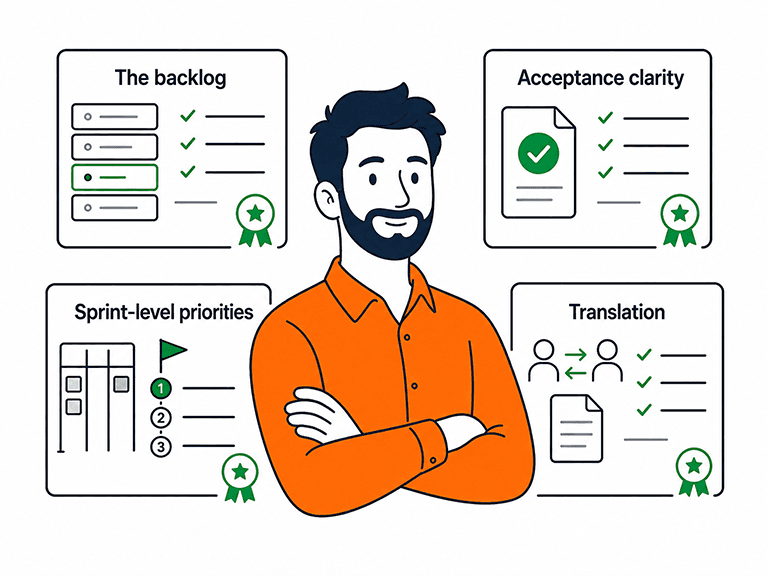
77 governed templates, guided drafting and a workspace built around delivery.