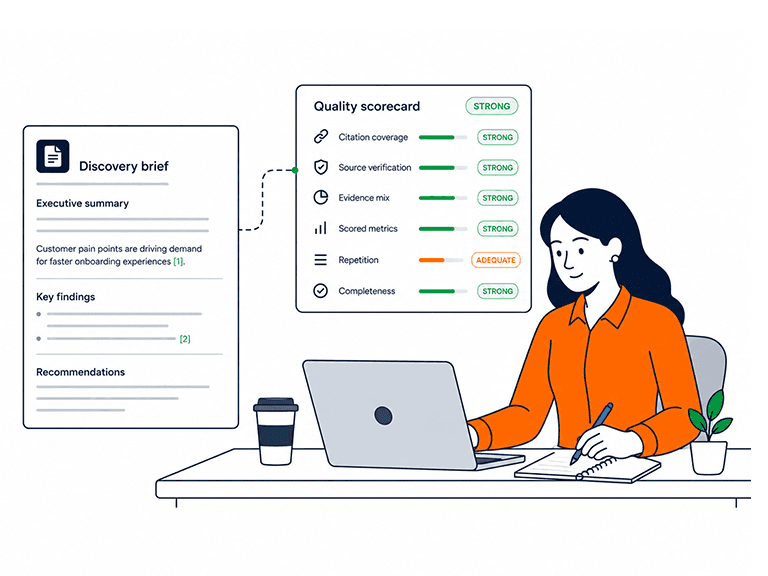
A free scorecard reads quality live as you edit. When it matters, a paid editorial review examines the document the way a demanding editor would - and fixes findings one section at a time, on your say-so.

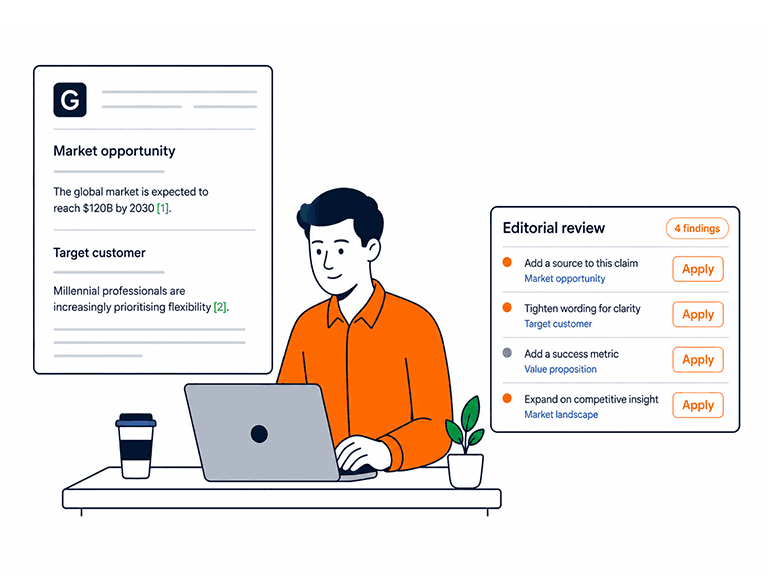
Gensudo’s editorial review provides a focused second opinion on your document, identifying specific weaknesses across six quality dimensions. Each finding explains the issue, shows exactly where it appears and includes an Apply action that improves only the affected section, leaving the rest of your document unchanged.

Most quality problems are structural rather than grammatical: repeated points, overlong sections, unsupported comparisons or recommendations that ignore counter-evidence. Generic AI feedback rarely helps. Useful review identifies the exact weakness, shows where it appears and suggests a focused improvement that you can accept or leave.
Six dimensions update live with every edit: citation coverage, source verification, evidence mix, scored matrices, repetition and section completeness. No credits, no waiting — the read is always current.
The editorial review works through the document as an exacting editor would, across six dimensions: repetition, right-sizing, citation coverage, scored matrices, counter-evidence and evidence mix.
Each finding points at a specific section and a specific weakness — an over-long section, an unscored matrix, a recommendation missing its counter-evidence — rather than vague encouragement.
Every finding carries an Apply action that re-drafts exactly that section to address it. Nothing else in the document is touched, and you choose which findings deserve the fix.

Most quality checks arrive after the writing is done, when fixing anything feels like starting over. Gensudo's scorecard reads the document continuously — six dimensions, updated as you type — so weak citation coverage or creeping repetition shows up while the fix is still cheap.

An editorial finding without a path to a fix is just criticism. In Gensudo, each editorial-review finding carries an Apply action that re-drafts precisely the section in question to address that weakness, leaving the rest of your document exactly as you wrote it. The re-draft arrives for your review, like every AI change in Gensudo.
Review in Gensudo is priced plainly and positioned honestly: it sharpens your judgement, it does not stand in for it.
The live scorecard is free on every document. Editorial reviews and critiques draw on your plan’s AI credits, and fair billing applies throughout — failed AI requests are never charged.
See plans and credit top-ups →Review findings are advice from an exacting reader, not a verdict. You choose which findings to Apply, and unreviewed AI output is never treated as final.
Review will not rewrite your document wholesale, approve it for release, or judge whether your strategy is right. It measures the craft of the document — the decision stays with the humans who sign it off.
Guidance for document owners →The six-dimension quality scorecard is free on every document and updates live as you edit. The editorial review returns per-section findings with Apply actions; the critique returns readiness, strengths, gaps, risk flags and next edits. Both draw on your plan’s AI credits. Failed AI requests are never charged.
The editorial review works line-close, like an exacting editor: specific findings in specific sections across repetition, right-sizing, citation coverage, scored matrices, counter-evidence and evidence mix, each with an Apply fix. The critique steps back for a document-level read — readiness, strengths, gaps, risk flags and suggested next edits. Many teams use the review to fix and the critique to decide.
Exactly one thing: the section that finding points at is re-drafted to address the named weakness. No other section is touched, your facts and figures are preserved, and the re-draft arrives for you to review rather than being silently written into the document.
Treat it as instrumentation, not absolution. The scorecard measures observable properties of the document — citation coverage, repetition, completeness and more — which makes weaknesses visible early. It cannot judge whether your strategy is sound or your evidence well-chosen; those calls remain professional judgement, which the tooling exists to support.
No. Every finding is advisory. You decide which ones merit an Apply, which to address by hand, and which to disagree with — a legitimate outcome, since an editor's read is an informed opinion, not an instruction. Sign-off stays a human act throughout.
Write with the live scorecard, and bring in the editor when the document matters.