Get the document written - without losing your facts or your voice

Gensudo turns your project's context into complete, cited drafts of the documents product decisions depend on. You stay the editor: every draft arrives as a suggestion, never a silent change.

Get StartedSee how research grounds each draft
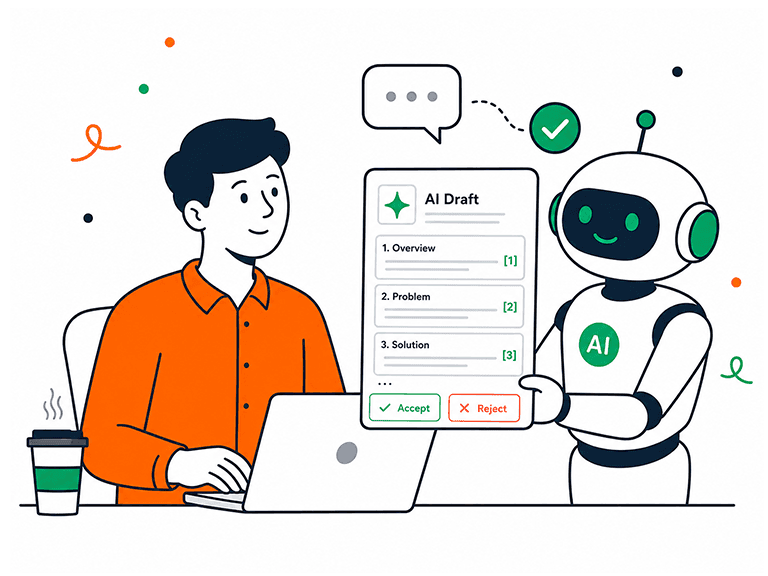
An AI draft card listing Overview, Problem and Solution sections with citations, and Accept or Reject buttons

AI drafting, built around your project

Gensudo drafts complete product documents, including PRDs, business cases and discovery briefs - using your project’s context. Documents are created section by section, with inline citations showing where key information comes from. Each draft is presented as a suggestion for you to accept or reject, never applied without your approval.

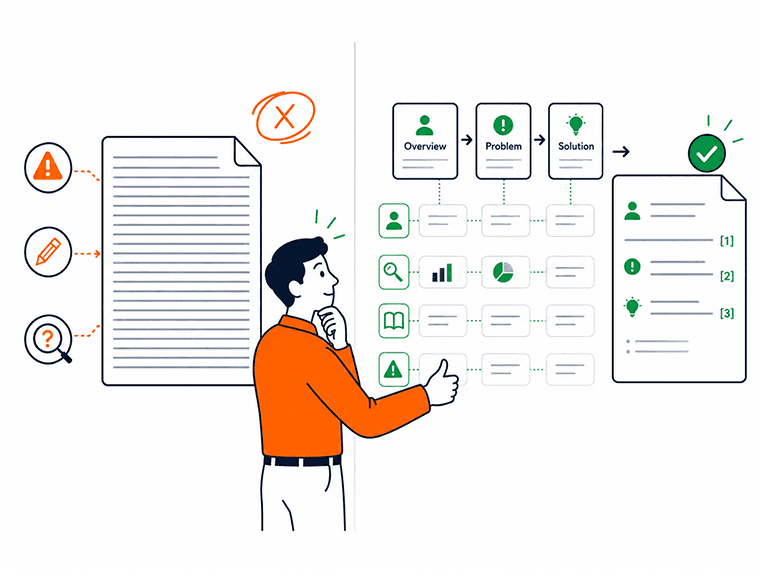
A rejected wall of unsourced AI text beside a structured draft with Overview, Problem and Solution sections and numbered citations

Why AI drafts usually get rewritten

Most AI writing tools produce a wall of confident text without showing their working. There are no sources, little understanding of the document’s purpose and no respect for the facts you have already established. The result is content you have to rewrite - while the sections you keep are often the hardest to verify. Decision-grade documents are not created through a single prompt. They are built as a sequence of purposeful sections, each with its own evidence requirements, context and acknowledged gaps. That is how Gensudo drafts.

How a draft comes together

  1. 1

    Choose a governed template

    Pick from 382 templates organised by role and lifecycle phase — a Product Requirements Document, a Business Case, a Product Discovery Brief. Each carries guidance on why it matters now and what good looks like.

  2. 2

    Run the full draft

    One click, charged once. Sections draft one at a time, grounded in your project context and the project's evidence pool. If a run fails partway, it resumes where it stopped — you are never charged twice.

  3. 3

    Review each suggestion

    Drafted sections arrive as suggestions to accept or reject. Nothing is silently applied, and each section's draft is checked against what that section is supposed to contain before it reaches you.

  4. 4

    Improve section by section

    Per-section Improve refines the writing while preserving your facts and figures. Your numbers stay your numbers — the AI tightens the argument around them.

  5. 5

    Keep the gaps honest

    When something genuinely is not knowable, the draft says so plainly. You will never find an [insert here] placeholder pretending to be a finished thought.

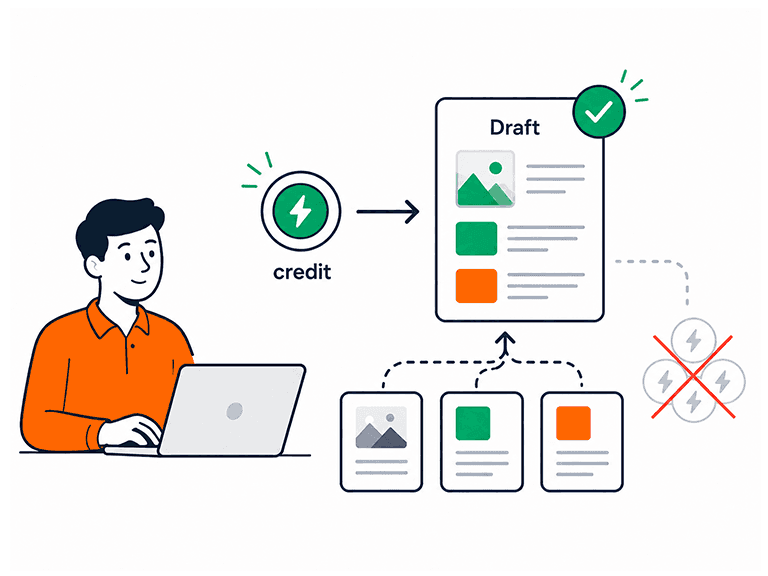
Credit spend producing a complete multi-section draft, with repeat charges crossed out

One charge, section by section, no lost work

A full draft is a chunked run: each section is drafted, validated and offered in turn. Because the whole run is charged once up front, a network wobble or a failed section never costs you again - the draft simply picks up where it left off.

  • One charge for a complete draft
  • Sections draft one at a time, in template order
  • Failed runs resume without re-charging
  • Fair billing across the platform: failed AI requests are not charged
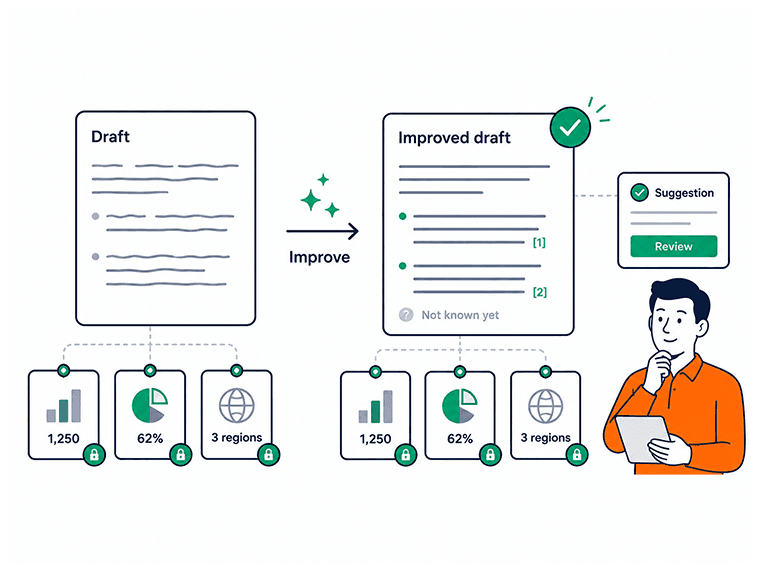
A draft improved into a cited version while locked figures of 1,250, 62% and 3 regions stay unchanged

Improve rewrites the prose, not your evidence

Per-section Improve treats the facts and figures you have added as fixed points. It sharpens structure and argument around them, cites what it draws on, and - where the honest answer is 'we do not know yet' - writes exactly that. Then a review pass can push quality further.

  • User-entered facts and figures are preserved through refinement
  • Drafts cite their sources with inline [N] markers
  • Honest-gap policy: unknowable information is named, not padded
  • Every change lands as a reviewable suggestion

Controls and honest limits

AI drafting in Gensudo supports your professional judgement — it never replaces it. Here is exactly where the boundaries sit.

What it costs

A full document draft is charged once, however many sections it takes and however many times a failed run resumes. Failed AI requests are never charged.

See plans and credits

You review everything

Drafts and improvements are suggestions to accept or reject. Unreviewed AI output is never treated as final — sign-off remains a human act, and the templates say who should give it.

What it will not do

It will not invent statistics, fabricate customers, or hide a gap behind a placeholder. And a citation is a trail to follow, not a guarantee of truth — checking still belongs to you.

How citations and trust work

AI drafting, asked plainly

How much does a full document draft cost?

A full draft is charged once against your plan’s AI credits, whatever the document’s size. Sections then draft one at a time, and if a run fails it resumes without re-charging. Gensudo bills fairly across the board: failed AI requests are never charged. The Pro plan includes 200 AI credits per cycle at £19 per month.

Will the AI overwrite my edits or my numbers?

No. Every draft and every per-section Improve arrives as a suggestion you accept or reject — nothing is silently applied. Improve specifically preserves the facts and figures you have entered, refining the writing around them rather than replacing them.

How accurate are the drafts?

Drafts are grounded in your project's context and its evidence pool, and claims carry inline citation markers so you can trace where they came from. That makes them checkable, not infallible: AI supports professional judgement rather than replacing it, and a citation is an invitation to verify, not a guarantee. Review before you rely.

What happens when the AI does not know something?

It says so. Gensudo's honest-gap policy means that when information genuinely is not knowable — a metric you have not measured, a decision not yet taken — the draft states the gap plainly instead of inventing a figure or leaving an [insert here] placeholder.

Which documents can Gensudo draft?

Any of the 382 governed templates in the library, organised by role and lifecycle phase — from a Product Requirements Document or Business Case to a Competitive Analysis, Product Roadmap, Persona Document or Product Sunset Assessment. Each template carries guidance on why it matters now and what good looks like.

Can I improve just one section rather than re-drafting everything?

Yes. Per-section Improve refines a single section while preserving your facts and figures, so you can iterate on the weakest part of a document without touching the rest. A full draft is only needed when you are starting a document from its template.
Your next document, drafted with its evidence attached

Set up one project, and see what a cited, decision-grade draft looks like against your own context.

Get Started