For Product Managers
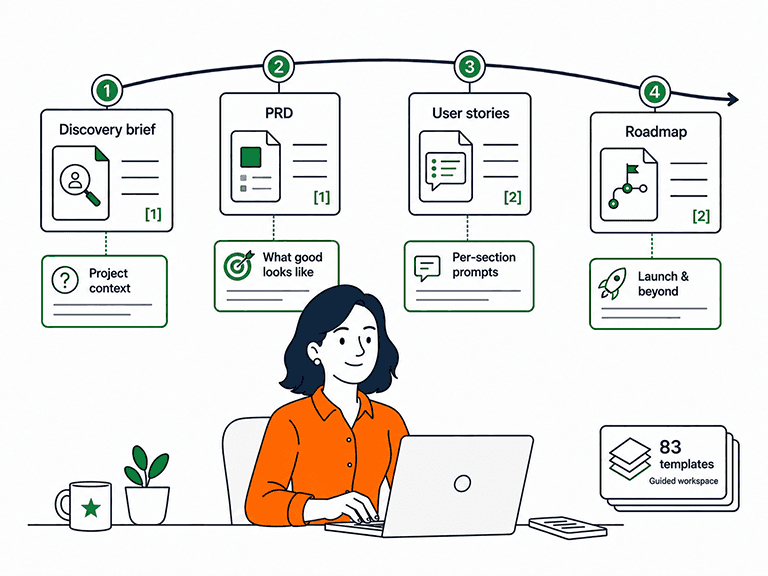
Discovery briefs on Monday, a PRD by Wednesday, launch comms looming. The writing never stops, and it all has to be right. Gensudo drafts the documents with you - 83 governed templates, cited and grounded in your project's own context.

A Product Manager owns one product’s journey end to end: understanding the problem, proving it is worth solving, defining the solution, and getting it launched and improved. Few roles carry the full thread in the same way, which is why Product Managers are responsible for so many document types.

Gensudo drafts the documents a Product Manager carries from discovery to launch - discovery briefs, PRDs, user stories and roadmaps - using your project’s own context, inline citations and an AI persona tuned to the PM craft. With 83 governed templates in one guided workspace, Gensudo helps you move faster without lowering the bar. Every template includes per-section prompts and a clear statement of what good looks like, so the blank page is never really blank and your judgement stays in charge throughout.
Product Managers get 83 governed templates in Gensudo - spanning all eight phases, deepest in Plan with 19 and Optimise with 14, because deciding and learning are where PM time actually goes.
The front of the funnel: the Product Discovery Brief, the Jobs-to-be-Done Analysis and the Persona Document turn hunches into framed, researchable problems.
PM discover templates →Proof before commitment. The Demand Validation Report and the Product-Market Fit Assessment answer the question stakeholders will ask anyway: how do we know anyone wants this?
PM validate templates →The deepest phase for PMs. The Product Roadmap, the RICE Scoring Sheet and the Business Case are where trade-offs stop being conversations and become commitments.
PM plan templates →Precision work: the Product Requirements Document (PRD) and User Stories, written so the build team never has to guess your intent.
PM define templates →Keeping the paperwork true while the product takes shape — User Stories refined as scope moves, the Customer Journey Map updated as the real flows emerge.
PM build templates →The Product Launch Checklist anchors the run-up, with an OKR Alignment Document making success measurable before the release, not after.
PM launch templates →The second-deepest phase, because shipping is the midpoint. A refreshed Competitive Analysis and a new Opportunity Assessment turn post-launch data into the next iteration's case.
PM optimise templates →Even endings need a PM. The Product Sunset Assessment and the Product Retirement Business Case close a product down with the same discipline that opened it.
PM scale or sunset templates →The PM problems Gensudo goes after: the hours lost to drafting, the claims you cannot back up, and the context scattered across ten tools.
A full draft is charged once; sections draft one at a time and a failed run resumes without re-charging. Per-section Improve refines while preserving your facts and figures — and everything arrives as a suggestion to accept or reject, never silently applied.
AI document drafting →A shared, project-level evidence pool covers six categories from competitor intel to customer jobs-to-be-done. It runs once per project per category, is cached around 30 days, and is bundled — it never costs you credits. Findings without a usable source URL get dropped.
Evidence and research →Dashboard, kanban, timeline, calendar and flow views over every document, with a workflow graph showing what each needs before it and unblocks next. Your discovery brief, PRD and launch checklist stop living in three different tools.
Lifecycle workspace →A full document draft is charged once. Sections then draft one at a time, and if a run fails it resumes without re-charging — failed AI requests are never billed. Drafts arrive as suggestions for you to accept or reject; nothing is applied to your document without you saying so.
No. Per-section Improve refines a section while preserving your facts and figures, and every AI output — draft or improvement — is presented as a suggestion you explicitly accept or reject. Unreviewed AI output is never treated as final, and nothing is silently applied.
From a project-level research pool spanning six categories: competitor intel, market sizing and trends, benchmarks and standards, regulatory and compliance, technology and integration, and customer jobs-to-be-done. Every finding must have a usable source URL or it is dropped, and you can add your own facts, which are treated as first-party. Inline citation markers then trace each claim in the draft back to its source.
The draft says so plainly. Gensudo's honest-gap policy means you never get an insert-here placeholder dressed up as content — when information is not knowable, the document admits it. And when a document needs context you have not provided, Gensudo asks for it just-in-time rather than guessing.
Pro costs £19 per month and includes unlimited projects, 200 AI credits each month, the complete template library, web-grounded research and AI document reviews. Additional credits can be purchased when needed, and you can cancel at any time. Failed AI requests are never charged.
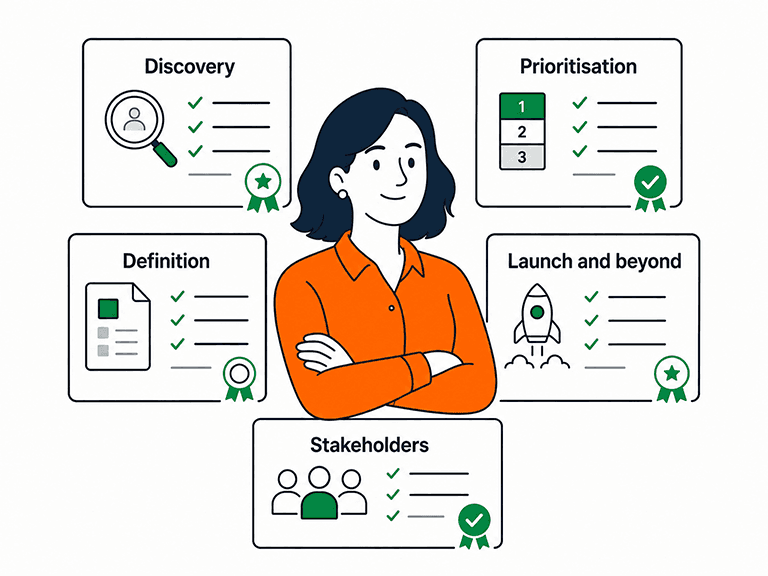
83 templates, cited drafts and one guided workspace from discovery to launch.