For Product Directors
Fund this team or that one. Ship now or hold. A Product Director's week is a queue of judgement calls between exec strategy and team delivery - and each one gets challenged. Gensudo puts 66 governed templates and cited drafting behind every steer.

A Product Director sits in the translation layer. Above you, executives want a coherent investment story; below you, several product teams need decisions, air cover and a consistent bar for quality. Your role is to keep those two worlds aligned.

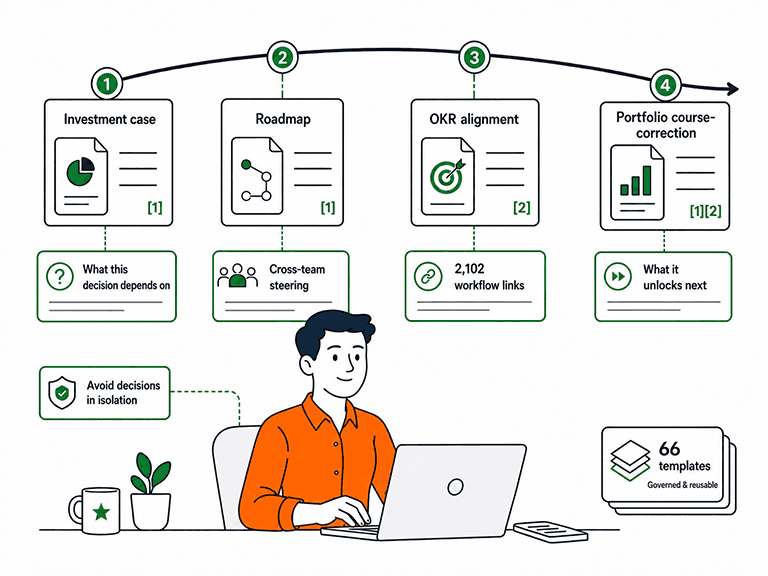
Gensudo gives Product Directors 66 governed templates and an AI drafting persona tuned to directing across products — from investment cases and roadmaps to OKR alignment and portfolio course-corrections. Drafts include inline citations, while Gensudo’s workflow graph connects documents through 2,102 dependency relationships, showing what each decision depends on and what it unlocks next. The result is a more consistent, evidence-led way to steer multiple teams without decisions being made in isolation.
A Product Director gets 66 governed templates in Gensudo, spread across all eight lifecycle phases but concentrated where directors do their real work: Plan, with 15 templates, and Optimise, with 11.
Directors rarely run discovery themselves, but they frame it. A Competitive Analysis or a Market Research Report set the terms for what the teams go and investigate.
PD discover templates →This is where funding requests land on your desk. The Opportunity Assessment and the Business Case are the working documents of an investment decision.
PD validate temlplates →The director's home ground. The OKR Alignment Document, the Product Roadmap and the RICE Scoring Sheet turn several teams' ambitions into one prioritised, defensible plan.
PD plan templates →Definition work you review and standardise rather than author line-by-line: the Product Requirements Document (PRD) and the Persona Document, held to a consistent bar across teams.
PD define templates →Delivery-phase documents that keep you close without hovering - User Stories and the Customer Journey Map among them.
PD build templates →Release gates and readiness. The Product Launch Checklist sits here, alongside a Demand Validation Report confirming the demand evidence still stands before go-live.
PD launch templates →The second-largest phase for this role, because steering is mostly course-correction. A Product-Market Fit Assessment or an updated Customer Journey Map tell you which products deserve more investment - and which are drifting.
PD optimise templates →Directors inherit the hard endings. The Product Retirement Business Case and the Product Sunset Assessment make winding something down a reasoned decision rather than a quiet abandonment.
PD scale or sunset templates →Directing across products means arguing from evidence, tracing where claims come from, and never re-explaining context to every new document.
Research runs once per project across six categories — competitor intel, market sizing, benchmarks, regulatory, technology and customer jobs-to-be-done — cached around 30 days and bundled, so it never costs credits. Findings without a usable source URL are dropped.
Evidence and research →Inline citation markers map each claim to a source list, and provenance shows whether it came from your project data, researched sources or AI synthesis. When sources conflict, Gensudo surfaces it and lets you label the canonical value.
Trust and citations →A project fact store lets later documents reuse facts established in earlier ones, so the business case, the roadmap and the OKR document argue from the same numbers. Missing context is asked for just-in-time, when a document actually needs it.
Project context →With evidence you can interrogate. Business cases, opportunity assessments and RICE scoring are drafted from your project's context and a shared research pool, with inline citations tracing each claim to its source. A free trust rail reads readiness per section, so you can see which parts of a case are well-evidenced and which are thin before you commit budget.
That is what the governed library is for. Gensudo holds 382 templates organised by role and phase, each carrying guidance on why it matters now, sign-off requirements and what good looks like, with per-section prompts. Teams working from the same templates produce documents you can actually compare side by side.
Research is bundled — it never costs the customer credits. It runs once per project per category across six categories and is cached for around 30 days. Any finding without a usable source URL is dropped rather than kept as an unverifiable claim.
Gensudo shows you the conflict rather than quietly picking a side. You can see disagreements between sources, verify the ones you trust, and label a canonical value for a metric — after which the labelled value is what grounds your drafts. The judgement stays yours; the workspace makes the disagreement visible.
Team Premium is the best fit for directors managing multiple teams, projects and workstreams. It includes shared workspaces, collaboration and structured review workflows, alongside a higher AI credit allowance. It costs £59 per seat per month. For teams with lighter AI usage, Team Standard is £25 per seat per month.
66 governed templates, cited drafting and a shared evidence pool - get started and put your next trade-off on paper properly.