For Heads of Product
Board packs, portfolio calls, exec scrutiny - a Head of Product answers for all of it, usually without a strategy office behind them. Gensudo gives you 72 governed templates and cited, decision-grade drafts you can stand behind.

The Head of Product is where product accountability concentrates. You set the vision, decide where the portfolio invests, and answer to the board for the outcomes. The role is less about writing every document and more about ensuring every important decision is defensible.

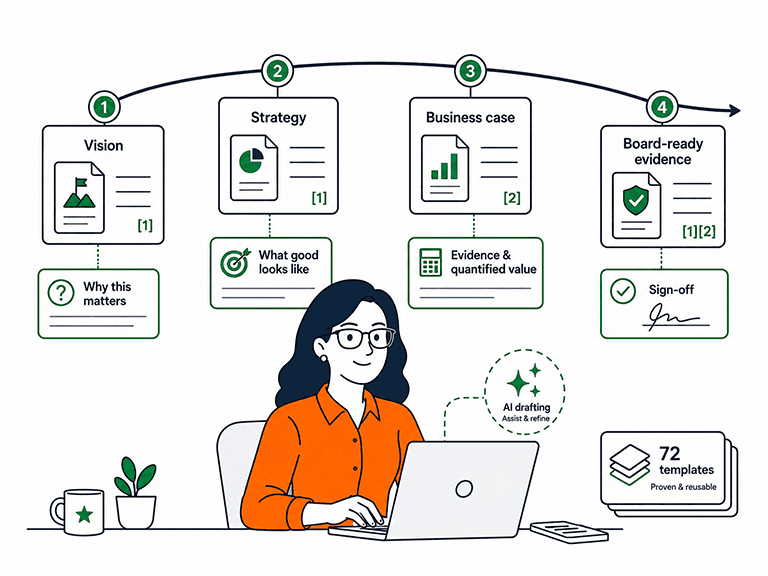
Gensudo gives Heads of Product a guided workspace of 72 templates across the full product lifecycle, with AI drafting that produces cited, decision-grade documents - from vision and strategy to business cases and board-ready evidence. Every template includes guidance on why it matters, what good looks like and who should sign it off, giving you the structure and digital mentorship to make stronger decisions without having to define the process from scratch.
Gensudo gives Heads of Product 72 governed templates organised across the eight lifecycle phases, weighted heavily towards Plan - because that is where this role earns its keep.
The strategic groundwork: documents such as the Market Research Report and the Opportunity Assessment, framing where the portfolio should look next.
HoP discover templates →Before money moves, the case gets made. The Business Case and the Product-Market Fit Assessment are typical here - evidence assembled for an investment decision.
HoP validate templates →The largest phase for this role. The Product Vision Statement, the Product Roadmap and the OKR Alignment Document all live here: the documents that align a leadership team around a direction.
HoP plan templates →A lighter phase for a Head of Product - oversight rather than authorship. The Product Requirements Document (PRD) and the Persona Document are the kind of work you review and sign off.
HoP define templates →Documents that keep delivery honest without micromanaging it, such as User Stories and the Customer Journey Map kept current as the build progresses.
HoP build templates →Go-to-market readiness, anchored by the Product Launch Checklist alongside a final Competitive Analysis pass on positioning.
HoP launch templates →Post-launch judgement calls: a RICE Scoring Sheet to order the improvement backlog, a fresh Product-Market Fit Assessment to test whether the thesis still holds.
HoP optimise templates →The decisions only a Head of Product can make. The Product Sunset Assessment and the Product Retirement Business Case give an ending the same rigour as a beginning.
HoP scale or sunset templates →Three things matter most at the top of the product function: evidence you can trace, an editor who pushes back, and a single view of everything in flight.
Documents carry inline citation markers matched to a visible source list, with provenance for every claim — your project data, researched sources, or AI synthesis. The same citations travel into Word and PDF exports for the board pack.
Trust and citations →A paid editorial review reads your document across six dimensions — repetition, right-sizing, citation coverage, scored matrices, counter-evidence, evidence mix — with an Apply action that re-drafts exactly the section each finding points at.
Editorial review →Dashboard, kanban, timeline, calendar and flow views over every document, connected by a workflow graph that shows what each one needs before it and unblocks after it. Portfolio oversight without chasing status.
Lifecycle workspace →Every document Gensudo drafts carries inline citation markers matched to a source list, and a free trust rail reads readiness as trust times coverage, section by section. When you export to Word or PDF, the citations and source list travel with the document — so what reaches the board is evidence-backed and traceable, not just well-written.
That is the role it was built for. Gensudo positions itself as a digital mentor: each of its 72 Head of Product templates explains why the document matters now, who needs to sign it off, and what good looks like, with per-section prompts as you write. It is the guidance a strategy office would give, available whenever you draft.
No. Gensudo's AI supports professional judgement rather than replacing it. Drafts arrive as suggestions you accept or reject — nothing is silently applied — and critique output is advisory. The strategy calls remain yours; the workspace makes sure they are documented and evidenced properly.
Yes. Team Standard and Team Premium let you invite colleagues to collaborate on projects, contribute to documents and take part in structured review cycles. Team Standard costs £25 per seat per month, while Team Premium costs £59 per seat per month and includes a higher AI credit allowance.
Gensudo does not currently offer a free plan. Individual subscriptions start with Pro at £19 per month, while team subscriptions start with Team Standard at £25 per seat per month. Each plan includes AI credits, and failed AI requests are never charged.
Explore the 72 Head of Product templates, and see what decision-grade looks like.