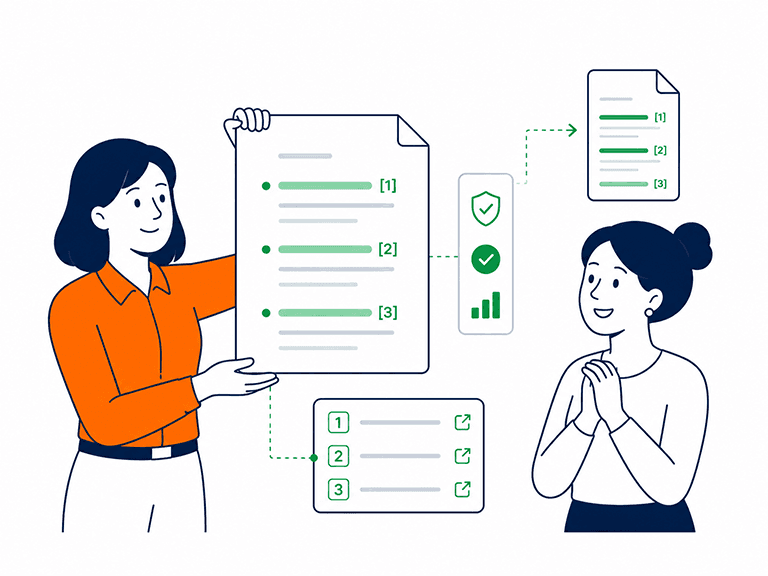
Inline citations, visible provenance and a free trust rail show exactly what every claim rests on — before a stakeholder asks, and all the way into the exported file.

Gensudo adds inline citation markers linked to a numbered source list. The same references are carried into Word and PDF exports, so the evidence remains visible wherever the document is shared. A deterministic trust rail shows how well-supported each document is using readiness, trust and coverage scores. Per-section indicators and clickable findings make it easy to inspect the evidence before sign-off.

A document’s weakest moment often comes when someone asks, “Says who?”. Most AI-assisted writing makes that question harder to answer by presenting confident claims without visible origins. Trust should not be based on how convincing a document sounds. It should be something you can inspect claim by claim and section by section - and something that survives the export.
Drafted claims carry inline [N] markers that match a numbered source list on the document. Follow a marker and you land on the source behind the sentence.
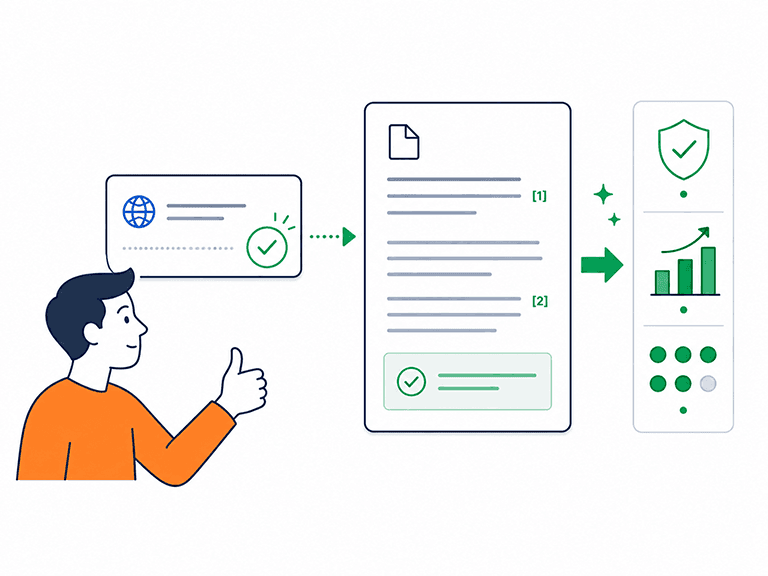
A deterministic, free trust rail computes Readiness = trust × coverage, with per-section bands showing where the document is well-evidenced and where it is thin.
Clickable verify, risk and strength findings turn the read into a to-do list: confirm this source, shore up that section, note where the document is already strong.
Confirming a source says what the document claims lifts the document's readiness. Leaving sources unverified is neutral — never a penalty — so the signal only ever rewards work done.
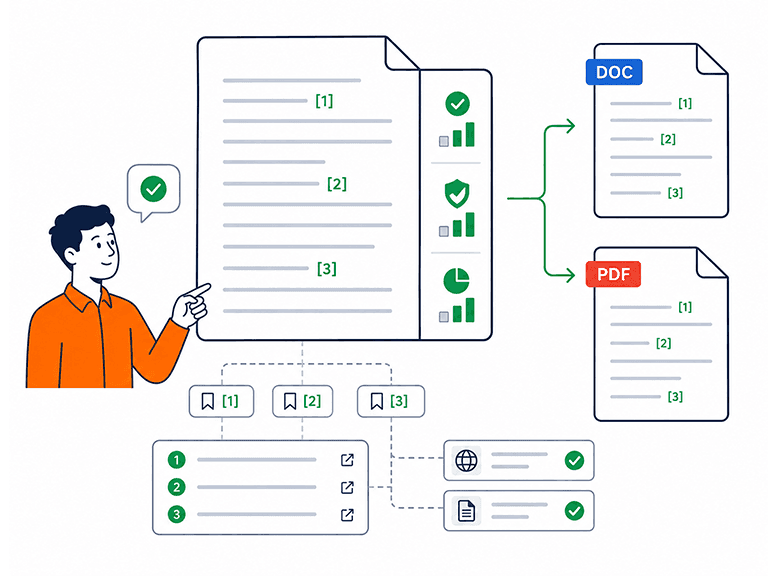
Word and PDF exports carry the same citation markers and the same source list as the editor. What reviewers see is what the document actually rests on.

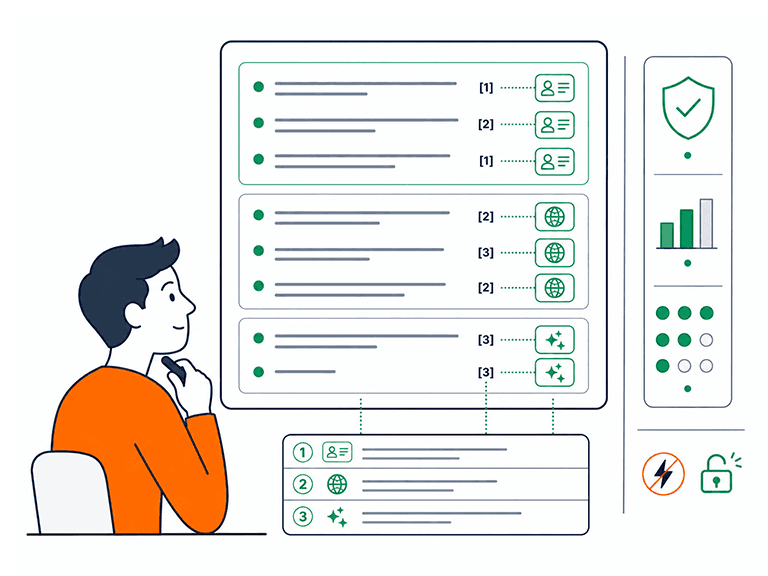
Not all evidence is equal, and Gensudo does not pretend it is. Claims trace to one of three origins — your project data, researched sources, or AI synthesis — and that provenance is visible in the document. Readers can weigh a first-party metric differently from a synthesised summary, because they can tell them apart.

Trust is built deliberately, so the mechanics reward effort instead of manufacturing anxiety. Verify a source and the document's read improves; leave it unverified and nothing is deducted. The result is a readiness score you can raise with real work, backed by a pool of evidence you control.
The trust system is built to inform your judgement, not to perform certainty it does not have.
The trust rail costs nothing and uses no credits. It is a deterministic read of the document in front of you — the same document always produces the same result.
Paid review goes deeper →A citation shows where a claim came from so you can check it. It never guarantees the claim is true — that judgement stays with you, which is why provenance is made visible at all.
The trust rail will not block a document, approve one on your behalf, or penalise you for sources you have not yet verified. Sign-off is a human decision, and templates state whose.
How drafts earn their citations →It is the trust rail's plain-language formula: readiness reflects both how trustworthy the document's evidence is and how much of the document that evidence covers. Per-section bands break the read down, so a strong section cannot hide a thin one — and clickable findings show exactly what would improve either half.
No — and any tool that implies otherwise is overselling. Citations make claims traceable: each inline [N] marker leads to a numbered source you can inspect. Whether that source is credible, current and correctly represented is a judgement Gensudo helps you make, with provenance and a verify loop, but never makes for you.
No. The trust rail is free and deterministic, updating as the document changes without spending anything. Credits are reserved for generative work — drafting, editorial review and critique — while the trust read is always on.
Never. Verification is a positive-only signal: confirming a source lifts the document's read, while unverified sources stay neutral. The design rewards evidence work you choose to do rather than punishing work you have not got to yet.
Yes. Word and PDF exports carry the same inline citation markers and the same source list as the editor, so the document you circulate for sign-off shows its evidence exactly as you saw it while writing.
Provenance is visible on the document: claims trace to your project data, to researched sources, or to AI synthesis. That distinction is deliberate — a reader should weigh a first-party figure differently from a synthesised summary, and Gensudo makes sure they can.
Get started and put your next document on the trust rail - citations inline, provenance visible, sources in the export.